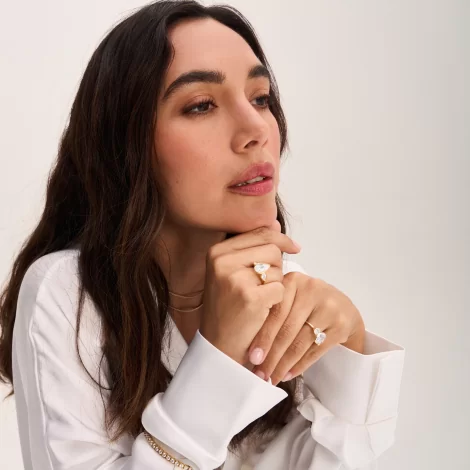
The ring on your left hand is one of the few things you wear every single day, in every context, for the rest of your life. That makes it a fairly honest signal. Shape, setting, and metal each carry associations, and the combination you land on tends to say something recognizable about the person wearing it.
If you’re wondering what type of engagement ring fits your personality, the answer is usually simpler than it seems. The ring that suits you is the one whose shape, setting, and metal align with how you already dress, what jewelry you already reach for, and how you actually spend your days. It rarely requires a personality test. It requires paying attention to what you already gravitate toward.
This guide walks through what each element of engagement rings communicates, then groups those elements into five style directions so you can find the one that reads most like you. We’ll cover practical considerations too, because the ring that fits your personality also has to fit your life. Along the way, you’ll find Sylvie settings that illustrate each direction.
What Your Engagement Ring Says About You
Three variables do most of the talking: the shape of the center stone, the setting that holds it, and the metal it’s built in. Each one operates differently. Shape is what people notice from across a room, setting is what they register when they take your hand, and metal is the tone underneath both. Understanding what each one signals makes it easier to build a ring that reads the way you want it to.
Why Diamond Shape Reads First
Center stone shape is the most legible element of any engagement ring. It’s the outline, the silhouette, the thing visible before any detail resolves.
Round engagement rings carry the longest history and read as traditional, which is exactly why so many people choose them. Oval engagement rings elongate the finger and have become the shape of choice for anyone who wants something classic with a more current edge. Emerald cut diamond engagement rings are the quietest of the popular shapes, favoring clean geometry and open planes over brilliance, and they tend to appeal to people with a restrained, architectural eye. Pear engagement rings and marquise engagement rings read as more distinctive, chosen by people who want their ring to be identifiable. Princess cut engagement rings and radiant engagement rings bring sharper corners and a more assertive presence.
None of these associations are rules. Plenty of traditional people wear pear-shaped diamonds. But shape is the first thing anyone reads, so it’s worth knowing what it tends to communicate. Check our our guide: What Is The Most Classic Shape for Engagement Rings? To learn more about these center stone shapes.
Why the Setting Says More Than You Think
Two people can choose the same center stone shape and end up with rings that look nothing alike. The setting is where that difference lives, and it often reveals more about personal taste than the shape does.
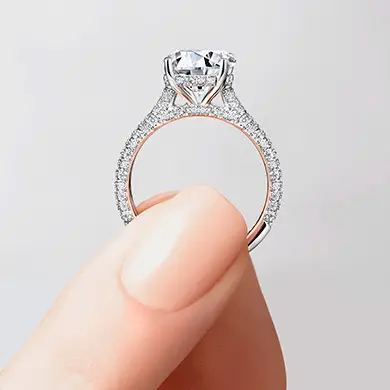
A solitaire setting puts everything on the center stone and nothing else, which suits people who prefer one strong element to several competing ones. Halo engagement rings features a center with accent diamonds for more presence overall, while hidden halo engagement rings place that detail beneath the stone so it only appears in profile, a choice that tends to appeal to people who like a private detail more than an obvious one. Three-stone settings carry their own symbolism and give the design more horizontal weight. A bezel engagement ring wraps the stone in a continuous metal rim for a clean, modern outline. Classic engagement rings feature pavé diamonds along the band, adding light across the whole ring rather than concentrating it in one place.
Setting choice is where personality tends to show up most specifically, because it’s a decision about how much, and where.
What Your Metal Choice Signals
Metal is the tonal decision. It affects how the whole ring reads and how it sits against everything else you wear.
White gold engagement rings and platinum engagement rings create a cool, clean frame that keeps attention on the stone and pairs easily with the silver-toned jewelry many people already own. Yellow gold engagement rings are warmer and more traditional, and it has come back strongly among people who want their ring to feel a little less standard than white metal. Rose gold engagement rings are softer and more distinctive, chosen by people comfortable with something that stands slightly apart. Two-tone engagement ring designs combine metals in a single ring, which suits anyone who already mixes their jewelry rather than matching it.
The most reliable way to choose is to look at what’s already in your jewelry box. If everything you own is warm-toned, a white gold ring will sit apart from the rest of your collection every day.
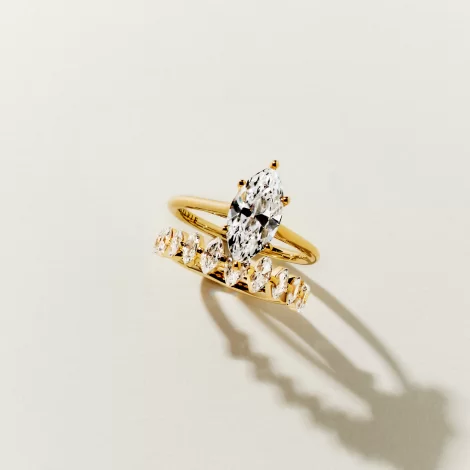
(From top to bottom) Marquise Cut Solitaire Engagement Ring – Dominique and Heritage Shared Prong Marquise Diamond Wedding Ring – B282
What Type of Engagement Ring Fits Your Personality?
Below are five style directions, each with the shapes, settings, and metals that tend to suit it. Read them as patterns rather than verdicts. Most people recognize themselves in one clearly and borrow an element or two from another, which is exactly how it should work.
The Classic
You gravitate toward things that hold up. Your wardrobe leans on well-made basics, your jewelry is understated and worn constantly, and you’re generally suspicious of anything that feels like a moment rather than a decision.
Best ring for you if:
- You’d rather own one excellent piece than three trend-driven ones
- You want a ring your daughter would wear without altering it
- You find yourself drawn to symmetry and clean proportion
A round or emerald cut center stone in a solitaire or three-stone setting is the natural fit here, built in platinum or white gold. If you want a little more, a slim pavé band adds light without changing the character of the ring. The Classic doesn’t mean plain. It means every element is doing necessary work.
The Romantic
You’re drawn to softness, detail, and the parts of a design that reveal themselves slowly. You like things with a little sentiment built in, and you notice craftsmanship in small places.
Best ring for you if:
- You’re drawn to curved lines over sharp corners
- You like the idea of a detail only you know is there
- Warm metals feel more like you than cool ones
Oval, cushion, or pear shapes suit this direction, paired with a halo, a hidden halo, or petal-inspired prongs that soften the setting head. Yellow or rose gold reinforces the warmth. A hidden accent diamond beneath the center stone is a particularly Romantic choice, since the whole point is that almost no one sees it.
The Modern Minimalist
You edit. Your instinct with any decision is to remove rather than add, and you’d rather have one clean line than three decorative ones. You notice proportion and negative space.
Best ring for you if:
- You want the ring to look intentional rather than ornate
- Clean geometry appeals to you more than detail
- You’d choose architectural over romantic every time
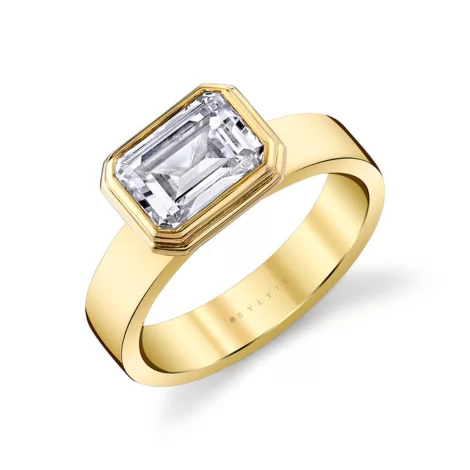
Emerald and oval shapes work well here, as does an east-west orientation that turns an elongated stone across the finger rather than along it. A bezel setting or a flat-edge band gives the ring a defined, contemporary outline. White gold or platinum keeps the palette cool and uninterrupted. The Modern Minimalist ring should look considered from every angle, including the profile.
The Bold
You don’t mind being looked at. You dress with intent, you like a strong silhouette, and a ring that goes unnoticed would be a disappointment.
Best ring for you if:
- You want presence on the hand, not subtlety
- Wide bands and strong proportions appeal to you
- You’d rather your ring start a conversation than blend into your hand
Radiant, princess, marquise, or elongated cushion shapes all deliver more visual weight. A wide band, a cathedral silhouette, or a substantial yellow gold setting builds on that. Chunky yellow gold in particular has become the shorthand for this direction, and it pairs well with a stone that has strong geometry. The Bold ring is built to be seen, and there’s nothing subtle about that intention.
The Individualist
You’d rather not wear what everyone else is wearing. You’re the person who finds the thing no one else has, and a ring that looks like the one in every engagement photo would feel like a missed opportunity.
Best ring for you if:
- You want a ring people ask about
- Standard configurations feel limiting rather than reassuring
- Something meaningful matters more to you than something expected
Less common shapes, unexpected orientations, and asymmetric detail all serve this direction. So does customization, which is where the Individualist usually ends up. Working with an authorized Sylvie retailer, you can start from an existing setting and adjust the details, add a hidden accent, incorporate a meaningful stone, or build something that doesn’t exist yet. That process is covered further below.
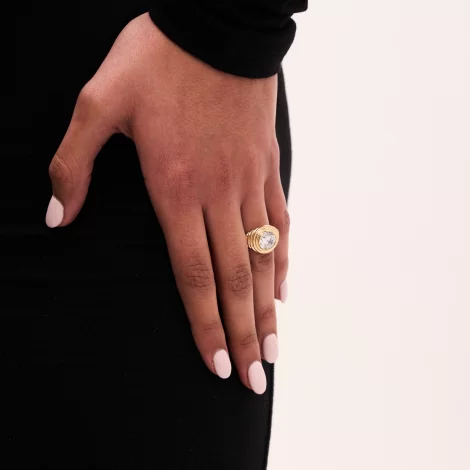
Choosing a Ring That Fits Your Life, Not Just Your Style
Personality is one input. The other is what your hands actually do all day. A ring that suits your style but not your life becomes a ring you take off, and a ring you take off isn’t doing its job.
How You Use Your Hands
If your work is hands-on, if you’re at a keyboard for eight hours, if you lift or garden or cook constantly, the profile of your setting matters. A bezel or lower-profile design has less to catch on and sits closer to the finger, which makes it easier to wear without thinking about it.
Higher settings give the center stone more presence and let light in from more angles, and they’re perfectly wearable when they’re well built. What matters is construction: strong, well-proportioned prongs and a setting head engineered for daily wear. Ask about that specifically rather than assuming a lower ring is automatically a safer one.
What Maintenance You’re Willing to Do
Every ring needs occasional attention. Prongs should be checked periodically to confirm they’re holding securely. White gold is finished with rhodium plating that wears over time and needs reapplying to keep its brightness. Pavé and halo settings have more small stones and more places for buildup to collect, so they benefit from more frequent cleaning.
None of this is difficult, but it’s worth knowing before you choose. If you’d rather have a ring you almost never think about, yellow gold in a simple setting asks the least of you.
Personal Style Versus Current Trends
Some of what feels like personal taste right now is a trend you’ve absorbed, and that’s fine. Trends become popular because they genuinely look good. The question is whether you’ll still want it in a decade.
A useful test: look at the fine jewelry you’ve owned longest and still wear. That’s a better indicator of your actual taste than what you’ve saved recently. If a current trend overlaps with that, it’s probably a safe choice. If it doesn’t, consider whether the trend belongs in your ring or somewhere easier to change, like wedding rings that you may add later.
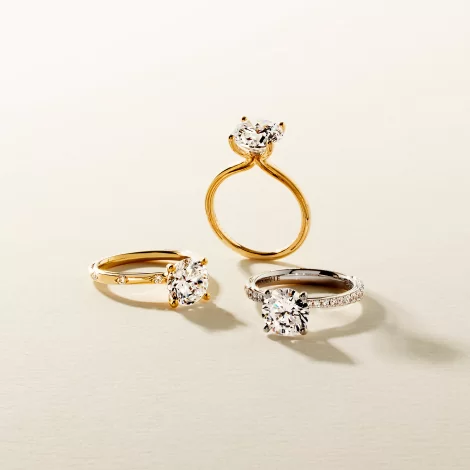
(From left to right) Iconelle Two Tone Shell Flush Set Engagement Ring – Anya, Iconelle Solitaire Two Tone Engagement Ring – Cecily, and Iconelle Tapered Engagement Ring – Blaire
When You Want Something Beyond the Traditional
A diamond center stone isn’t the only option, and for some people it isn’t the right one. A meaningful colored gemstone, a birthstone accent, or a design element that doesn’t exist in any standard configuration can turn a ring into something genuinely personal.
At Sylvie, alternate gemstones and personalized design details are handled through our customization process rather than as ready-made options. You begin with a setting you love, then work with an authorized Sylvie retailer to adapt it: incorporating a colored stone, adding a hidden accent, adjusting the diamond detail, or building on an existing silhouette to create something new. It’s a collaborative process, and the retailer guides you through it.
This route suits the Individualist most obviously, but it isn’t limited to one style direction. A Classic who wants a specific engraving inside the band and a Romantic who wants a birthstone set beneath the center stone are both customizing. The difference is only in how far the change goes.
Sylvie Engagement Rings by Personality Type
Each of the settings below illustrates one of the five directions covered above. Every Sylvie engagement ring is a semi-mount, designed to hold a center stone you select separately with the help of an authorized retailer.
The Classic: Kalla
The Kalla setting, from our Auravie collection, carries graduated accent diamonds channel set into the band, larger at the center and tapering as they move toward the finger. The channel construction keeps the surface smooth and the line uninterrupted, so the detail reads as structural rather than decorative. It is a considered choice for anyone drawn to symmetry and clean proportion, with enough presence to stand on its own and no element that will feel dated in twenty years.
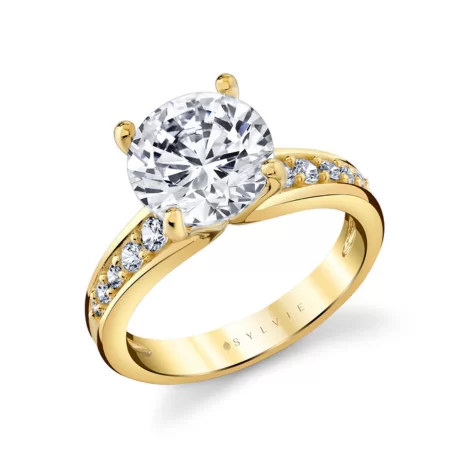
The Romantic: Zinnia
The Zinnia setting comes from Tulira, our nature-inspired collection, and translates leaf forms into the architecture of the ring itself. The organic detailing softens the setting head and gives the design movement that a straight band cannot, which is exactly what the Romantic direction asks for. This is a setting that rewards a closer look, with craftsmanship that reveals itself when someone takes your hand rather than announcing itself across a room.
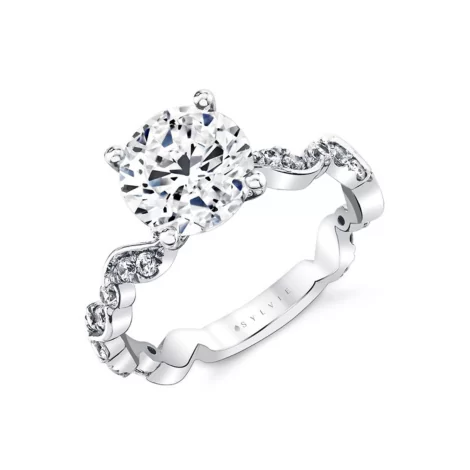
The Modern Minimalist: Pippa
The Pippa setting pairs a bezel with a flat edge band, two of the cleanest structural choices available in an engagement ring. The bezel wraps the center stone in a continuous metal outline, while the flat edge gives the band a defined, architectural profile against the finger. Nothing here is ornamental. For anyone whose instinct is to remove rather than add, this setting is the direction distilled.
The Bold: Mariselle
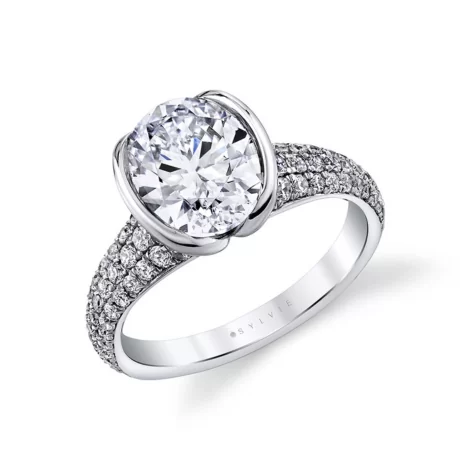
The Mariselle setting brings together a half bezel, pavé accent diamonds, and the shell tip silhouettes that give our Shell Auranova collection its identity. The half bezel frames the center stone on two sides while leaving the profile open, and the shell detailing carries real visual weight from every angle. This is a setting built to be noticed, with more happening across the design than a plain solitaire could offer.
The Individualist: Fallon
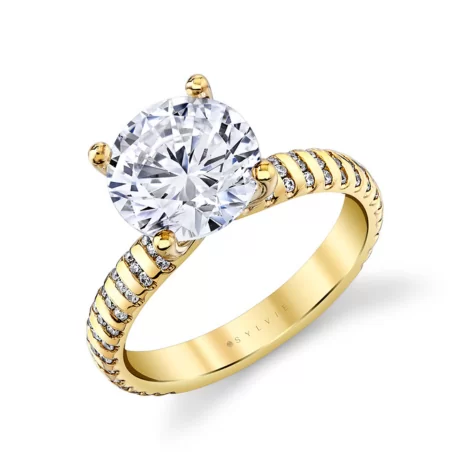
The Fallon setting takes an unexpected approach to accent diamonds, setting them level with the surface of the band rather than raising them above it. The result is a band that catches light without the texture of a traditional pavé, which is a genuinely less common choice. It also makes a strong starting point for customization, since the clean construction gives an authorized retailer room to adapt the details into something no one else is wearing.
Frequently Asked Questions
What does my engagement ring say about my personality?
The shape, setting, and metal you choose each carry associations. Shape reads first and tends to signal how traditional or distinctive your taste is, setting reveals how much detail you like and where you like it, and metal reflects your broader style. Together they form a reasonably accurate picture of how you approach design decisions generally.
Which engagement ring style matches my personality?
Start with what you already wear. If your jewelry is minimal and cool-toned, a bezel or clean solitaire in white gold or platinum will likely feel right. If you wear warm metals and like detail, a halo or hidden halo in yellow or rose gold is a closer match. The ring that suits you usually resembles what’s already in your jewelry box.
Does the setting or the diamond shape say more about you?
Shape is more visible, but setting is more specific. Two people can both choose an oval and end up with completely different rings depending on whether they set it in a plain solitaire or a detailed halo. If you want your ring to reflect your taste precisely, the setting is where that happens.
What engagement ring suits a classic personality?
A round or emerald cut center stone in a solitaire or three-stone setting, built in platinum or white gold. The defining quality is restraint: clean proportion, no unnecessary detail, and a design that won’t read as dated in twenty years.
What engagement ring suits a modern personality?
Clean geometry and defined lines. An emerald or oval center stone in a bezel setting or on a flat-edge band, in white gold or platinum. East-west orientation, where an elongated stone sits across the finger, is another distinctly modern choice.
How do I choose a ring that fits my lifestyle?
Consider what your hands do daily. Hands-on work favors a lower-profile setting with less to catch on. Also consider maintenance: white gold needs periodic rhodium plating, and settings with many small diamonds need more regular cleaning. A well-constructed setting with strong prongs is wearable in almost any situation, so ask about construction rather than assuming.
Does mixing metals or stones reflect personal style?
It often does. Choosing a two-tone setting or a colored gemstone accent usually signals someone comfortable making a less standard choice. It’s also practical, since a two-tone ring pairs easily with jewelry in either metal. At Sylvie, colored gemstones are incorporated through the customization process with an authorized retailer.
Finding the Ring That Feels Like You
Every element of an engagement ring communicates something, but the goal isn’t to engineer a message. It’s to end up with a ring that’s recognizably yours, one that looks like it belongs on your hand rather than on anyone else’s.
The most reliable way to get there is to try things on. Photographs flatten proportion, and a shape that looked wrong online can look entirely different on your actual hand. An authorized Sylvie retailer can show you settings across every direction covered here, help you narrow down what genuinely appeals to you, and guide you through selecting the center stone that completes the design.
Whatever you choose, the right ring is the one you’ll still recognize as yours decades from now.