What is an emerald cut diamond? It’s defined by its rectangular shape, cropped corners, and linear facets that create a smooth interplay of light, a look prized for its clean geometry and quiet sophistication. In this guide, we’ll explore the origins of the emerald cut, its distinctive features, the role of its facets in enhancing beauty, and why this refined design continues to captivate modern brides and collectors alike.
Key Characteristics of the Emerald Cut Diamond
Defined by precision and proportion, the emerald cut diamond stands apart for its refined structure and subtle depth. Unlike brilliant cuts that emphasize sparkle, the emerald cut highlights clarity and symmetry, offering a composed, architectural appearance.
Its elongated shape and stepped pattern of facets create flashes of light rather than scattered brilliance, giving the stone its distinct sense of calm radiance. Understanding these visual characteristics, along with how they influence perception of size and light, helps reveal why emerald cut diamonds remain a favorite among those drawn to understated elegance.
Shape & Facet Structure – The Hall of Mirrors Effect
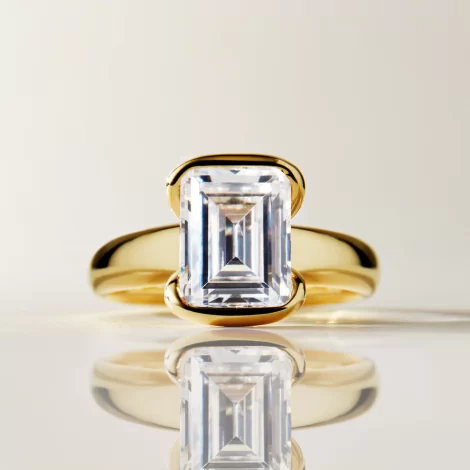
The emerald cut’s structure is instantly recognizable: a rectangular outline with cropped corners and layered, parallel facets that run lengthwise across the stone. Known as step-cut faceting, this formation produces a sleek, mirror-like reflection pattern often described as the hall of mirrors effect.
Typically, there are 57 to 58 facets in an emerald cut diamond, arranged in steps on the crown and pavilion that emphasize clarity and depth. The broad, open table showcases the diamond’s interior, meaning inclusions are more visible, making high clarity grades particularly desirable. The linear symmetry of emerald cut facets enhances this balance, resulting in a diamond that glows with composure rather than sparkle.
Emerald Cut Size Appearance
Because of its elongated form and large surface area, an emerald cut diamond often appears larger than other shapes of equal carat weight. The eye naturally follows its length, creating a graceful slimming effect on the finger and an impression of expanded dimension.
This visual generosity, paired with its refined geometry, makes emerald cut diamond engagement rings a choice that feels both minimal and commanding. The elongated silhouette also allows for creative versatility, whether set vertically for classic appeal or rotated east–west for a modern, design-driven look.
Emerald Cut Diamond Meaning & Appeal
The emerald cut diamond carries a meaning that extends beyond shape, it’s a reflection of clarity, confidence, and composure. Its clean lines and structured symmetry speak to those who find beauty in intention.
Where other cuts express brilliance through movement, the emerald cut reveals strength through stillness. Each facet becomes a window into precision and craftsmanship, creating a calm radiance that feels both enduring and modern. This quiet sense of refinement has made it a signature choice for those who see luxury not in excess, but in design that endures.
What Does Emerald Cut Mean for Style & Personality?
So, what does emerald cut mean when interpreted through personal style? The emerald cut diamond meaning aligns closely with authenticity, balance, and intention. Its deliberate form appeals to women and couples who appreciate structure and restraint, those who curate rather than collect, and who value thoughtful design over excess.
With its elongated silhouette and broad, open table, the emerald cut conveys self-assurance and composure. It’s often chosen by individuals who see their engagement ring as an extension of identity rather than ornament. In the context of engagement rings based on zodiac sign, this cut is frequently associated with Libra engagement rings and Virgo engagement rings, reflecting the traits those signs are known for: harmony, precision, and an eye for proportion.
For many, the emerald cut mirrors how they approach life itself, measured, graceful, and grounded. It doesn’t rely on excess brilliance to make a statement. Instead, the emerald cut earns attention through balance, presence, and a quiet strength that feels deeply personal.
Why People Fall in Love with Emerald Cut Diamonds
The appeal of emerald cut diamonds lies in how they interpret light and emotion differently from other shapes. Instead of brilliance that dazzles, their light moves in sleek, measured flashes that feel elegant and intimate. Each reflection highlights the diamond’s depth and the precision behind its creation. This clarity. both visual and symbolic, draws people who value honesty, artistry, and craftsmanship.
In relationships, the emerald cut often becomes a metaphor for transparency and trust: what you see is exactly what you get. Its architectural silhouette pairs beautifully with modern or vintage-inspired settings, allowing it to adapt effortlessly to personal expression. For those who seek refined simplicity with unmistakable presence, emerald cut diamonds embody a balance of artistry and emotion that continues to define true sophistication.
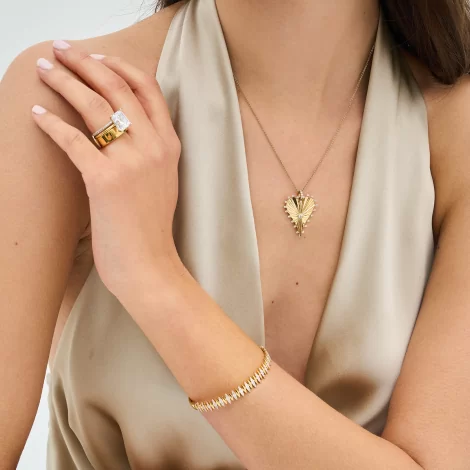
(from left to right) Polished Gold and Diamond Wedding Ring Enhancer – B252, Emerald Cut Solitaire Engagement Ring – Dominique, Linéaire Fine Line Diamond Heart Pendant – PS1015, and Tulira Two Tone Leaf Diamond Bangle – BGS1000
A Brief History of the Emerald Cut Diamond
The emerald cut diamond has a history defined by innovation, artistry, and enduring influence. Its origins trace back centuries to early gemstone cutting techniques that favored clean geometry over sparkle. While round engagement rings celebrate light, the emerald cut celebrates craftsmanship, its precision and symmetry a mark of early lapidary mastery.
Over time, this cut evolved into a symbol of refinement and modernism, finding renewed significance during the Art Deco movement, when architecture, fashion, and jewelry embraced structure and balance.
From Table Cut Origins to Art Deco Emerald Cut Variations
The emerald cut diamond history begins with the table cut, one of the earliest recorded gem-cutting styles, dating back to the 1500s. This early technique featured a flat top surface and simple facets, designed to protect the edges of softer stones such as emeralds while emphasizing their natural transparency.
As cutters experimented, they discovered that this structured form beautifully accentuated a diamond’s clarity and shape. Over time, jewelers refined the concept into what became known as the step cut, a series of broad, layered facets arranged like descending steps to create depth and reflection rather than sparkle.
By the early twentieth century, this evolution gave rise to the modern emerald cut, distinguished by its elongated facets, cropped corners, and refined symmetry. During the 1920s and 1930s, the Art Deco movement celebrated geometry and proportion, inspiring new emerald cut variations that mirrored the era’s architectural design language. The result was a diamond that felt both elegant and contemporary, admired for its balance and its ability to pair effortlessly with bold, structured settings.
Famous Emerald Cut Diamonds Through the Years
Throughout history, many renowned figures have chosen emerald diamonds for their effortless elegance. Icons such as Grace Kelly, Elizabeth Taylor, and Beyoncé have all worn emerald cut engagement rings, reinforcing the cut’s reputation as both regal and relevant.
Each of these stones reflected a different era’s vision of beauty, Grace’s classic simplicity, Taylor’s bold glamour, Beyoncé’s modern refinement, showing how the shape adapts without ever losing its composure. Whether worn by royalty or modern brides, the emerald cut diamond continues to represent clarity, artistry, and the timeless connection between form and emotion.
Emerald Cut Diamonds in the 4Cs – What to Look For
Evaluating an emerald cut diamond requires a slightly different lens than other shapes. Because this cut emphasizes clarity and symmetry over brilliance, its beauty depends heavily on proportion and precision.
Each of the 4Cs of diamonds, cut, color, clarity, and carat, interacts uniquely within the emerald cut, shaping how light flows across its long, open facets. Understanding these factors ensures your selection reflects both visual appeal and long-term value, highlighting why the emerald cut remains one of the most architectural and refined choices in diamond design.
Your Sylvie Authorized Retailer can help evaluate balance between the 4Cs and how much you should spend on an engagement ring, ensuring the diamond you select pairs perfectly with your plans.
Clarity in Emerald Cut Diamonds
Clarity plays the most significant role in how an emerald cut diamond appears. The open, rectangular top surface and long, linear facets act almost like windows into the stone, meaning inclusions are easier to spot than in brilliant cuts. Because of this transparency, high clarity diamond grades, typically VS2 and above, are preferred to maintain a flawless appearance to the naked eye. However, perfection isn’t always required; well-placed inclusions can remain invisible when aligned near the edges or corners.
Emerald Cut Diamond Color
Color subtly shapes the personality of an emerald cut. Since this style doesn’t rely on intense sparkle to mask tone, a near-colorless range (G–H) often achieves the best visual harmony, especially when paired with platinum engagement rings or white gold engagement rings. Slightly warmer tones, such as I–J, beautifully complement yellow gold engagement rings or https://www.sylviejewelry.com/engagement-rings/rose-gold/. Because emerald cut diamonds display color more clearly than round or radiant cuts, viewing stones side by side is essential to see how hue interacts with the chosen metal. The careful balance between warmth and brightness helps preserve the refined, understated character of the emerald cut.
Cut Quality & Proportions of the Emerald Cut
In the context of what are diamond cuts and what is a cut diamond, proportion is everything. The emerald cut is categorized as a step cut, meaning its facets are arranged in horizontal layers rather than triangular patterns. This geometry gives the stone its depth and structure.
An ideal length-to-width ratio typically ranges between 1.30 and 1.50, depending on personal preference. Precise symmetry and polished alignment are critical to creating that smooth flow of light across the surface. The cut doesn’t just shape brilliance, it defines the diamond’s character and visual rhythm.
Carat Weight, Price & Value of Emerald Cut Diamonds
Carat weight in emerald cut diamonds can be visually deceptive. Because of their elongated shape and open table, they often appear larger than their actual carat weight. This creates exceptional value compared to round or princess cuts of equal size. However, pricing depends heavily on clarity and color, given how easily imperfections are revealed.
Selecting the right balance among the 4Cs of diamonds ensures lasting beauty and investment confidence. Working with an authorized retailer familiar with precision cutting standards can help you identify the best combination of proportion, light performance, and price, qualities that make the emerald cut an enduring favorite for sophisticated design.
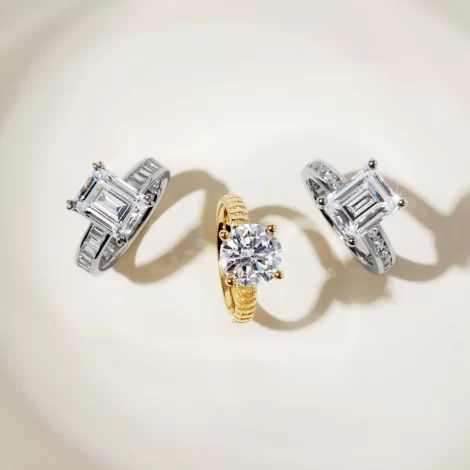
(from left to right) Auravie Channel Set Baguette Engagement Ring – Amren, Auravie Flush Set Diamond Engagement Ring – Fallon, Auravie Channel Set Round Diamond Engagement Ring – Juno
Emerald Cut Diamond Pros and Cons
Every diamond cut offers its own strengths, and the emerald cut diamond is no exception. Loved for its sculptural beauty and enduring form, it stands apart from brilliant cuts with its structured lines and subtle flashes of light. Yet, that same clarity and precision mean it requires thoughtful consideration when it comes to quality and maintenance. Understanding both the advantages and limitations helps ensure this refined style matches your lifestyle, aesthetic, and expectations.
Advantages of Emerald Cut Diamonds
One of the greatest strengths of the emerald cut diamond is its ability to showcase purity. The broad, open facets highlight a diamond’s interior rather than disguising it, revealing exceptional craftsmanship and quality. Because of its elongated shape, it often appears larger than other cuts of the same carat weight, making it a visually impactful yet elegant choice.
The clean geometry also lends itself beautifully to many settings, from modern bezels to classic solitaires, giving the design remarkable versatility. Brides who favor sophistication over sparkle are drawn to its calm radiance and the way it conveys strength through simplicity.
Disadvantages of Emerald Cut Diamonds
The same qualities that make the emerald cut diamond distinctive can also pose challenges. Its large, transparent surface means inclusions or color tints are easier to see, so clarity and color grades matter more here than in brilliant cuts. Because it reflects light in smooth flashes rather than intense sparkle, some may find it more understated than expected.
The rectangular shape can also emphasize any imbalance in proportion if not cut precisely. For those who value minimalism, these nuances enhance its appeal, but for anyone seeking maximum brilliance, another shape may better suit their style. When chosen thoughtfully, however, the emerald cut’s balance of structure, grace, and authenticity makes it one of the most enduring expressions of modern refinement.
Comparing Emerald Cut Diamonds With Other Cuts
Understanding what are diamond cuts helps reveal why the emerald cut stands out for its refined geometry and distinct character. Each cut interacts with light differently, some through brilliance, others through symmetry or depth. While round and princess cuts maximize sparkle, the emerald cut focuses on clarity, proportion, and graceful reflection. Comparing it with other popular shapes highlights the versatility and design depth behind emerald cut variations, offering guidance for those deciding which style best expresses their story.
Emerald Cut vs. Princess Cut Diamonds
When comparing emerald cut diamonds to princess cuts, the difference comes down to how each shape expresses brilliance and structure. Princess cut engagement rings are known for their sharp corners and dense network of triangular and kite-shaped facets, which produce bold sparkle and a distinctly modern look. If you’ve ever wondered what is a princess cut diamond, it’s a square or slightly rectangular shape designed to maximize light return through a brilliant-style faceting pattern.
The emerald cut, by contrast, takes a more architectural approach. Its long, parallel facets create soft, mirror-like flashes of light rather than intense sparkle. Cropped corners add durability, while the elongated rectangular silhouette visually lengthens the finger and emphasizes clean lines and proportion.
For those drawn to high-energy brilliance and contemporary drama, the princess cut delivers immediate impact. For individuals who prefer refinement, balance, and understated elegance, the emerald cut offers quiet confidence, making each shape a reflection of personal style rather than a question of which is better.
Emerald Cut vs. Radiant Cut Diamonds
When exploring the emerald cut vs radiant cut, the distinction lies in how each shape balances structure and brilliance. Although both share a similar rectangular outline, their faceting tells very different stories. If you’re asking what is a radiant cut diamond, it’s a hybrid design that blends the clean shape of an emerald cut with the sparkle-forward faceting of a brilliant cut. This combination gives radiant engagement rings their signature energy and vibrant light return.
The emerald cut diamond, by contrast, takes a more restrained approach. Its long, step-cut facets emphasize transparency, symmetry, and proportion rather than sparkle, making it especially suited for showcasing high clarity diamonds. Instead of glittering flashes, the emerald cut creates broad, mirror-like reflections that feel calm, composed, and architectural.
While radiant cuts appeal to those who love movement and brilliance, emerald cuts resonate with minimalists who appreciate precision and craftsmanship. Both designs celebrate balance, but the emerald cut’s layered, linear faceting delivers a refined “hall of mirrors” effect that feels intentional and enduring rather than dramatic.
Emerald Cut vs. Round, Oval & Other Diamond Cuts
When comparing emerald cuts with round, oval, and classic shapes for engagement rings, it becomes clear how strongly form influences both look and feeling. Round diamonds are celebrated for their unmatched brilliance and symmetry, while oval engagement rings offer similar sparkle with an elongated silhouette that flatters the finger through soft, continuous curves. These shapes tend to emphasize light performance first, creating an immediately radiant presence.
The emerald cut takes a different approach. Rather than prioritizing surface sparkle, it highlights balance, clarity, and proportion. Its clean lines and step-cut facets draw the eye inward, revealing the diamond’s structure and transparency in a way that feels composed and intentional. This distinction is often at the heart of conversations around oval vs emerald engagement rings, where the choice comes down to whether you’re drawn to brilliance and movement or to refinement and restraint.
While oval and round diamonds suit those who love classic sparkle with a modern ease, the emerald cut appeals to individuals who value precision and quiet confidence. Whether set in contemporary metal tones or paired with vintage-inspired engagement ring designs, the emerald cut continues to stand apart as a shape defined by elegance, clarity, and enduring design language.
Best Settings & Ring Designs for Emerald Cut Diamonds
The setting of an emerald cut diamond defines how its refined geometry interacts with light. Whether lifted in a cathedral setting or framed by a sleek bezel, the right design highlights the stone’s clarity, balance, and proportion. From classic solitaires to contemporary east–west orientations, each style reveals a different side of this enduring cut, and the artistry that defines Sylvie’s craftsmanship.
Classic Solitaire Emerald Cut Diamond Rings
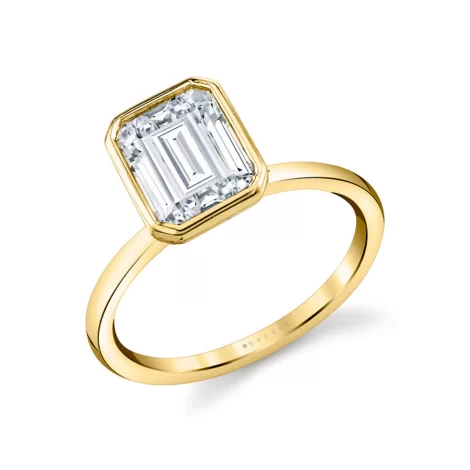
A classic engagement ring or a solitaire engagement ring allows an emerald cut diamond to speak for itself. Its clean lines and open facets thrive in minimalist designs that celebrate symmetry and restraint. Bezel styles offer a modern interpretation of this tradition, such as the Cliodhna engagement ring, which frames the emerald-cut center in a sculpted border of gold that enhances both brilliance and protection. Its smooth profile and polished finish reflect our commitment to craftsmanship and design longevity, creating a piece that feels elegant today and heirloom-worthy tomorrow.
Halo and Pavé Settings for Emerald Cut Diamonds
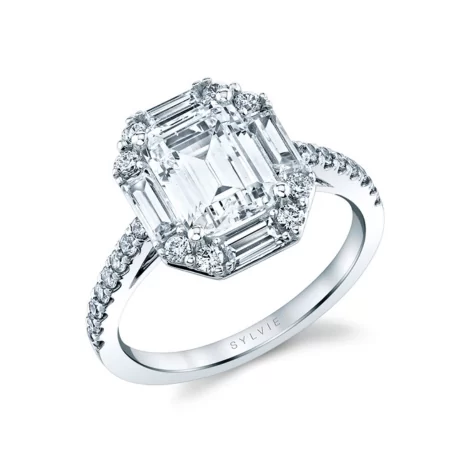
For those who appreciate subtle radiance, halo engagement rings and pavé settings bring refined dimension to the emerald cut. A delicate halo introduces soft contrast, while pavé detailing along the band adds shimmer without distraction. The Presley engagement ring captures this balance beautifully, its cathedral silhouette lifts the emerald-cut center to support the luminous halo of ground and baguette diamonds, creating movement and light from every angle. The result is a ring that feels quietly glamorous, where structure and softness coexist in perfect harmony.
Three-Stone Emerald Cut Diamond Rings
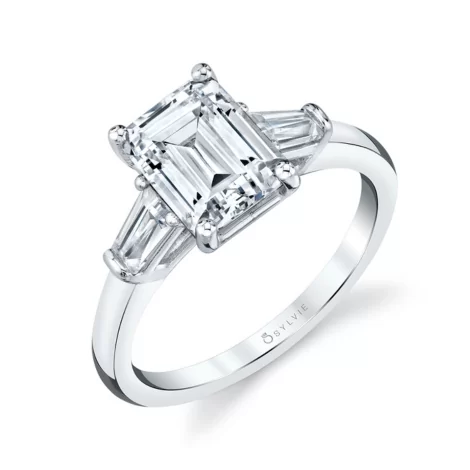
Three-stone engagement ring settings have long symbolized the journey of love, past, present, and future, and they pair naturally with the linear precision of emerald cut diamond designs. The Nicolette engagement ring embodies this symbolism, with two tapered baguette side stones framing the center diamond in flawless symmetry. The design’s high-polish band reinforces its meaning: enduring strength, balance, and devotion, expressed through proportion and light.
Modern Emerald Cut Diamond Variations – East-West
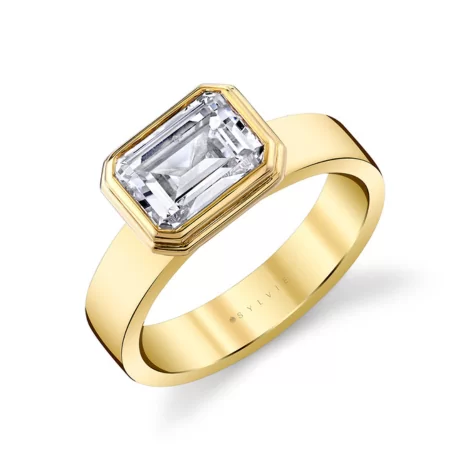
Modern interpretations of the emerald cut embrace new orientations without losing refinement. The east–west setting positions the diamond horizontally, adding a contemporary twist to a classic form. The Pippa engagement ring brings this vision to life, featuring an emerald-cut center encircled by a luminous stepped bezel. The wide band introduces warmth and an elevated take on tradition for the bride who sees beauty in reimagined classics.
The Sylvie Difference in Emerald Cut Diamond Rings
At Sylvie, every emerald cut ring begins with balance, between form and feeling. Our solitaire emerald cut engagement rings showcase purity of line and proportion, while our three-stone emerald engagement rings reflect the harmony of structure and symbolism. Each piece is crafted exclusively with natural diamonds and designed to endure, marrying modern craftsmanship with the emotion that defines every love story.
Conclusion – Why Emerald Cut Diamonds Endure in Style
The enduring appeal of the emerald cut diamond lies in its balance of structure and emotion. Its design reflects clarity, intention, and restraint, values that feel as relevant today as they did centuries ago. While trends evolve, the emerald cut remains constant in its quiet confidence, a style that never needs embellishment to be remembered.
Emerald Cut Diamonds as a Symbol of Love & Clarity
At its core, the beauty of emerald cut diamonds comes from transparency, every line, facet, and reflection visible by design. That openness mirrors the foundation of lasting love: honesty, balance, and trust.
For many couples, choosing an emerald diamond becomes a declaration of their shared values, an appreciation for authenticity and depth over excess. Whether set as a solitaire, framed by a halo, or paired with baguette side stones, it’s a cut that transforms precision into poetry.
To experience the craftsmanship and natural brilliance that define our emerald cut designs, we invite you to explore them in person at a Sylvie Authorized Retailer. There, our trusted partners can guide you in finding the piece that reflects your story, crafted with integrity, designed to endure, and made to be loved for a lifetime.
FAQ – Emerald Cut Diamond Questions Answered
Choosing the right diamond shape often comes with questions about price, brilliance, and proportions. The emerald cut diamond is admired for its symmetry and understated radiance, but understanding its unique qualities helps ensure it aligns with both your style and expectations.
Are emerald cut diamonds more expensive or less expensive?
Emerald cut diamonds are often priced slightly lower per carat than round brilliants, largely because they retain more of the rough diamond during cutting. However, higher clarity and color grades are recommended due to their open faceting, which can reveal imperfections.
Do emerald cut diamonds sparkle?
They don’t sparkle in the same way brilliant cuts do. Instead, emerald cuts display refined flashes of light that move rhythmically across the stone, a glow that feels elegant rather than intense.
Why choose an emerald cut diamond engagement ring?
An emerald cut engagement ring represents composure, sophistication, and authenticity. It appeals to those who value craftsmanship and prefer a diamond that speaks through proportion and design rather than brilliance alone.
Is a 1 carat emerald cut diamond big enough?
Because of their elongated shape and large surface area, emerald cut diamonds often appear larger than other cuts of the same weight. A one-carat stone can feel impressively substantial when well-proportioned.
How to make an emerald cut diamond appear more sparkly
Choosing a high-quality cut with balanced symmetry enhances light return. Pairing the diamond with a halo or pavé band also adds dimension, giving the appearance of greater brilliance while maintaining its refined character.